
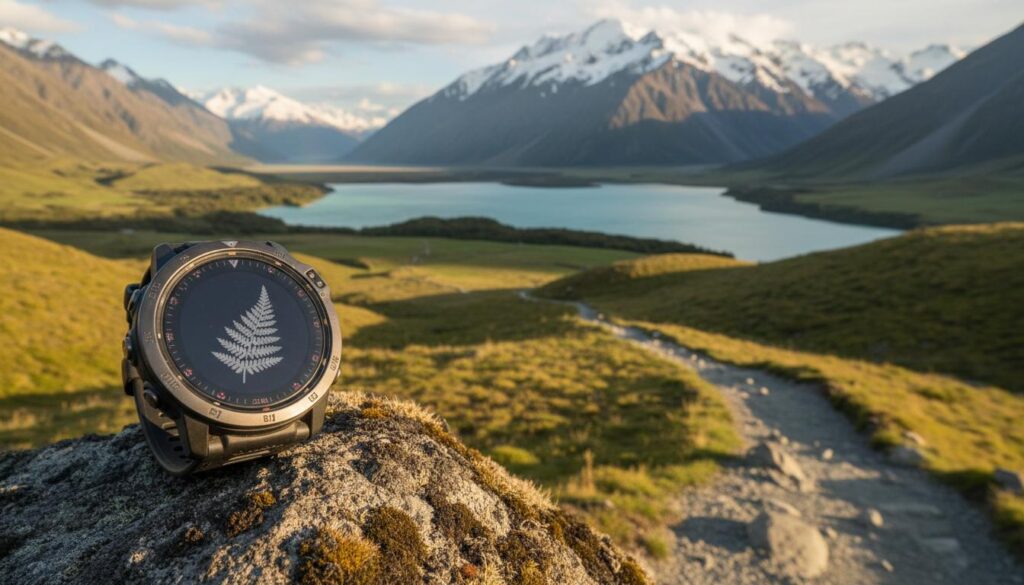
Chasing a reliable fitness companion for runs along the waterfront, tramps in the bush, or everyday health tracking? A garmin watch nz is built for our conditions—windy summits, salty surf, and muddy trails—and it’s far more than a step counter. This guide cuts through the noise to help you pick the right model, understand how it works, and get the best value in New Zealand.
Below, you’ll find plain-English answers, a comparison table of popular ranges, step-by-step setup, and local tips for maps, payments, and support. Whether you’re eyeing your first Garmin or upgrading, you’ll leave confident about what to buy and how to use it well.
What is
A garmin watch nz is a GPS-enabled smartwatch designed to track fitness, health, and outdoor activities with accuracy and long battery life. It connects to your phone, logs workouts and daily metrics, offers navigation, and supports safety and payment features. Unlike basic trackers, Garmin watches focus on performance insights and robust build quality suited to New Zealand’s varied terrain.
- Accurate GPS tracking for running, cycling, tramping, and watersports
- Advanced training tools like VO2 Max, training load, and recovery time
- Outdoor features: maps (on select models), altimeter, barometer, compass
- Health metrics: heart rate, sleep stages, stress, Pulse Ox (on many models)
- Smart features: notifications, music storage (selected models), Garmin Pay
How it works
Sensors and GPS
Garmin watches use a blend of sensors—optical heart-rate monitor, accelerometer, gyroscope, barometric altimeter, compass, and temperature sensor—to interpret movement and environment. GPS (and often GLONASS/Galileo, with multi-band on higher-end models) plots your route and pace. In dense bush, cliffs, or city canyons, multi-band GPS improves accuracy by reading multiple frequency signals to reduce errors.
Software and insights
Data from your watch syncs to the Garmin Connect app. That’s where you see maps, training metrics, and health trends. Features like Body Battery estimate energy levels, Training Readiness helps plan sessions, and Garmin Coach provides adaptive plans for 5K to marathon. The watch itself gives quick-glance widgets and post-workout summaries without reaching for your phone.
Navigation and maps
Map-enabled models (e.g., Fenix and Epix lines) store detailed maps so you can follow routes, find points of interest, and use turn-by-turn navigation—useful on Great Walks or new MTB trails. You can load GPX routes from planning tools and follow courses without cell signal. Non-map models still offer breadcrumb navigation and back-to-start.
Payments, music, and safety
- Garmin Pay lets you tap to pay; availability depends on your NZ bank and card. Check your bank’s support before buying.
- Music-enabled models store Spotify/Deezer/MP3 playlists for phone-free runs (Bluetooth earbuds required).
- Safety features like LiveTrack and incident detection can alert chosen contacts if something goes wrong—handy in areas with patchy coverage when paired to your phone.
Types / examples
Garmin makes several watch families. Here are the most relevant lines for a garmin watch nz, with what they’re best at.
| Series | Best for | Display | Battery (smartwatch / GPS) | Maps | Notable features | Water rating |
|---|---|---|---|---|---|---|
| Forerunner 55 / 165 / 265 / 965 | Runners and triathletes | MIP (55/965) or AMOLED (165/265/965) | ~2–10 days / ~10–31 hrs (model-dependent) | 965 has full maps; others basic navigation | Training load, running dynamics (with sensor), multi-band GPS on 965 | 5–10 ATM |
| Fenix 7/7 Pro | Adventure, tramping, multi-sport | MIP | ~10–18 days / ~36–89 hrs (plus solar options) | Yes (topo + routable) | Sturdy build, sapphire options, advanced navigation | 10 ATM |
| Epix (Gen 2/Pro) | Premium everyday + outdoors | AMOLED | ~6–16 days / ~30–75 hrs | Yes | Bright touch display, multi-band GPS, full maps | 10 ATM |
| Instinct 2 / 2X Solar | Rugged, surf, tactical, long battery | MIP (high-contrast) | ~28–40 days; solar models can extend | No full maps (breadcrumb nav) | Ultra-tough build, excellent battery, surf/tide profiles (on variants) | 10 ATM |
| Venu 3 | Health, daily wear, casual fitness | AMOLED | ~8–14 days / ~20–26 hrs | No full maps | Strong sleep/stress insights, on-wrist calls (with phone) | 5 ATM |
| Approach S70 | Golfers | AMOLED | ~10–16 days / ~15–20 hrs | Yes (golf courses) | Course maps, virtual caddie, playslike distance | 5 ATM |
| Descent G1 | Recreational diving | MIP | ~10–25 days / dive modes vary | No topo; dive modes/maps in app | Dive algorithms, surface GPS logging | Dive-rated |
Quick pointers for common Kiwi use cases:
- Hiking and Great Walks: Fenix 7/Pro or Epix for topo maps and long battery.
- Road and trail running: Forerunner 265 for AMOLED and training tools; 965 for maps and multi-band GPS.
- Triathlon and Ironman Taupō: Forerunner 965 or Fenix 7 for multi-sport ease, long battery, open-water swim tracking.
- Surf and coastal adventures: Instinct 2 Surf or compatible Fenix profiles; check for tide widgets.
- Everyday health with weekend workouts: Venu 3 for bright display and wellness features.
Pros and cons
Pros
- Excellent GPS accuracy, especially on multi-band models in bush and gorges
- Strong battery life compared to most smartwatches
- Rugged builds that handle rain, salt spray, and knocks
- Deep training metrics and recovery guidance for progress without burnout
- Offline navigation and maps on higher-end models—ideal when there’s no reception
- Wide ecosystem: Garmin Connect, third‑party app sync, and accessory support (ANT+/Bluetooth)
Cons
- Map-enabled and sapphire models can be expensive
- AMOLED screens reduce battery compared to MIP (all else equal)
- Optical heart rate can be less accurate during high-intensity intervals; a chest strap helps
- Feature set can feel complex at first; some setup time needed
How to use or choose
Step-by-step: first-week setup
- Charge fully, then power on and pair with the Garmin Connect app on your phone.
- Set units to metric, enable location, and allow background permissions for reliable syncing.
- Enter accurate age, height, weight, and max HR if known; set heart‑rate zones and training goals.
- Install updates and, if supported, download maps for New Zealand and your region.
- Enable safety features (LiveTrack, incident detection) and add emergency contacts.
- Set up Garmin Pay if your NZ bank supports it; add one card and test at a local terminal.
- Customise data screens for your main sports (pace, HR, elevation, lap time).
- Do an easy run/ride/walk to let the watch learn your baseline and calibrate metrics.
- Review sleep and Body Battery after a few nights; adjust training if recovery looks low.
- Back up settings in Garmin Connect and enable sync to your favourite platforms (e.g., Strava).
Buying tips for Kiwis
- Pick by battery and display: MIP for bright sun and long tramps; AMOLED for vibrant everyday use.
- Need maps? Choose Epix, Fenix, or Forerunner 965. They simplify navigation on DOC tracks and MTB parks.
- Size matters: Smaller wrists may prefer 42–46 mm cases; try in person for comfort and button reach.
- Water exposure: For regular ocean swims or surf, favour 10 ATM models and rinse with fresh water after salt.
- Sapphire lens and titanium add durability and reduce scratches from rocky terrain.
- Solar options extend battery in bright NZ summers; think Fenix/Instinct Solar if you spend long days outside.
- Payments: Confirm Garmin Pay support with your specific NZ bank and card type before you buy.
- Support and warranty: Buying from authorised NZ retailers simplifies returns and service under the Consumer Guarantees Act.
Common mistakes to avoid
- Overlooking maps when you regularly hike or travel off-grid
- Buying AMOLED for multi-day tramps without considering shorter battery life
- Ignoring strap comfort—switch to a softer silicone or nylon band for long activities
- Leaving auto pause on for trail runs; it can misread stops on technical terrain
- Relying only on wrist HR for intervals; use a chest strap for accuracy
FAQ
Which garmin watch nz is best for hiking and tramping?
Fenix 7/Pro and Epix models are top picks. They offer topo maps, multi-band GPS, solid battery life, and durable cases. If you want lighter weight and maps, the Forerunner 965 is a strong runner-up.
Do Garmin watches include New Zealand maps?
Map-enabled models can store detailed maps, and you can download regional map data through Garmin’s tools. Non-map models provide breadcrumb navigation and back-to-start but not full map screens.
Does Garmin Pay work in New Zealand?
Yes, Garmin Pay works in NZ where contactless payments are accepted, but bank support varies. Check your bank and card compatibility before purchase.
How accurate is GPS under bush cover or steep valleys?
Multi-band GPS significantly improves accuracy in challenging environments like native bush or gorges. For the most consistent tracks, choose Epix, Fenix 7 Pro, or Forerunner 965 and allow the watch a few seconds to lock satellites before you start.
Can I swim in salt water with a Garmin?
Many models are rated 10 ATM and are fine for ocean swims and surf. Rinse the watch with fresh water afterwards, and avoid pressing buttons underwater unless the model explicitly allows it.
What’s the battery life like for a garmin watch nz?
It varies by model and features. Rugged MIP models (e.g., Instinct, Fenix) can run for days to weeks in smartwatch mode and many hours in GPS. AMOLED models balance bright screens with slightly shorter runtimes. Solar variants extend life in bright conditions.
Will my watch work without mobile coverage on the track?
Yes. GPS and maps don’t require mobile coverage. Syncing, LiveTrack, and emergency contacts need a phone connection, but navigation and activity logging work fully offline.
What should runners choose: Forerunner 265 or 965?
Forerunner 265 suits most runners with AMOLED, great training tools, and lighter weight. Choose the 965 if you need full maps, longer GPS battery, and multi-band accuracy for races or complex routes.
Are Garmin watches good for New Zealand’s long summer days?
Yes. Readable screens (especially MIP), strong GPS, and options like solar charging make them ideal for big days outside—from sunrise hikes to late-evening rides.
Where should I buy a garmin watch nz?
Choose authorised NZ retailers or the official channel for local support, correct regional settings, and easier warranty claims under the Consumer Guarantees Act.
Do I need a chest strap?
For steady runs and daily tracking, the built-in optical sensor is usually enough. For intervals, sprints, or precise training load, a chest strap or upper-arm optical band improves accuracy.
Can I plan and follow routes on the watch?
Yes. Upload GPX routes to the watch via Garmin Connect. Map-enabled models show turn-by-turn guidance; others display a breadcrumb trail and back-to-start arrow.
Is a garmin watch nz suitable for multi-sport events?
Absolutely. Forerunner 965 and Fenix lines handle triathlon, duathlon, and custom multisport profiles with a single button press to switch disciplines and transitions.
How do I maintain the watch in NZ conditions?
- Rinse after salt or muddy use and dry before charging
- Update firmware regularly for bug fixes and new features
- Replace straps and screen protectors if worn to preserve comfort and clarity
Bottom line
If you want accurate tracking, honest battery life, and features that handle New Zealand’s wild mix of city, sea, and summit, a garmin watch nz is hard to beat. Choose the line that matches your priorities—maps and durability for the backcountry, lightness and training tools for running, or bright wellness features for daily wear—and you’ll have a watch that works as hard as you do.
More Stories
Glenfield Mall: A practical local guide to shops, parking, and smart ways to visit
Puffer jacket guide for New Zealand: warmth, weather, and the right fit
PB Tech Wellington: A Local’s Guide to Smart Tech Buying in the Capital