
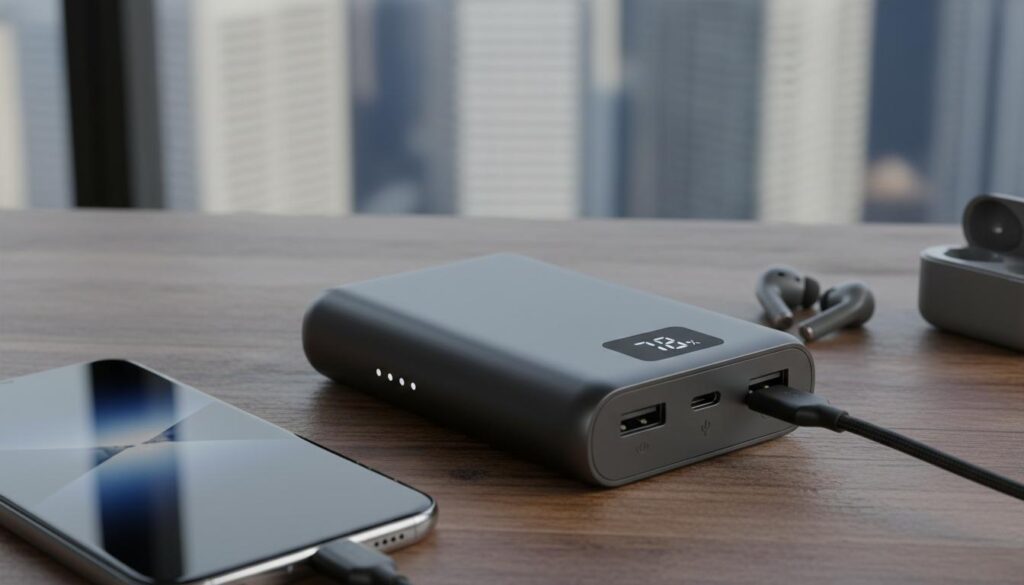
Your phone runs flat halfway up the Tongariro Crossing. Your tablet dies before the ferry pulls into Picton. A good power bank ends those low-battery dramas. This guide explains what a power bank is, how it works, the types worth considering, the real pros and cons, and exactly how to choose the right one for life in Aotearoa.
What is
A power bank is a portable battery you charge in advance, then use to recharge phones, tablets, earbuds, cameras, or even laptops on the go. You’ll also see it called a portable charger or battery pack. Most fit in a pocket or daypack; larger models can power USB‑C laptops and Nintendo Switch consoles, or keep a GPS tracker alive during a backcountry tramp.
For New Zealanders, a power bank is handy beyond travel: storm-related outages, long work commutes, school camps, festival weekends, and hut stays with no mains power. Buy from reputable local retailers so you get genuine cells, NZ warranties, and support.
How it works
Inside a power bank are rechargeable lithium-ion or lithium-polymer cells. These cells hold energy at about 3.6–3.7 volts. A small circuit boosts that voltage to standard USB levels (5V) or to higher USB-C Power Delivery (PD) levels (9V/12V/15V/20V) so it can fast-charge modern devices. Safety electronics manage temperature, over-current, and short circuits.
Capacity, explained simply
- mAh (milliamp-hours) is often printed large on the box, but it’s measured at the cell’s 3.7V.
- Wh (watt-hours) is the real energy figure (Wh = mAh × 3.7 ÷ 1000). Airlines use Wh.
- Conversion losses: energy is lost when boosting from 3.7V to 5–20V. Expect 70–80% of the stated Wh to reach your device in practice.
Charging standards you’ll see
- USB Power Delivery (USB‑C PD): the open standard for fast charging. Common outputs: 18W, 30W, 45W, 60W, 65W, 100W.
- PD 3.1 (EPR): newer, supports higher voltages for up to 140W+ on some gear, though most portable power banks top out at 100–140W due to airline limits.
- Quick Charge (QC): a Qualcomm protocol used by many Android phones. Often coexists with PD.
- Trickle or low‑power mode: prevents cut-off when charging devices like earbuds and watches.
Airline rules that matter
- Carry-on only. Power banks are not allowed in checked luggage.
- Up to 100Wh: generally permitted without airline approval.
- 100–160Wh: often allowed with airline approval; check before flying.
- Over 160Wh: not permitted on passenger flights.
Air New Zealand follows IATA guidance. Always verify current rules before you fly.
Cold weather note
Capacity drops in the cold. In alpine conditions or winter tramps, keep your power bank in an inside pocket to stay warm and deliver closer to rated output.
Types / examples
Pocket-size (around 5,000 mAh)
Small and light, good for one phone top-up. Ideal for quick city days or as a backup in your handbag or glovebox.
Everyday (10,000 mAh)
The sweet spot for most people. Two phone charges, often with 18–30W PD for fast charging a phone or small tablet.
Travel/work (20,000 mAh)
Plenty of buffer for weekends away, festivals, or a couple of days off-grid. Many offer 30–65W PD, enough to top up some USB‑C laptops.
Laptop class (up to ~26,800 mAh / ~99Wh)
Engineered to stay just under airline limits while delivering 60–100W PD—enough for MacBook Air, many ultrabooks, and USB‑C monitors. Heavier, but versatile.
Wireless and magnetic
Wireless power banks add Qi charging. MagSafe‑compatible units snap to the back of recent iPhones for cord‑free top-ups on the move. Efficiency is lower than wired charging.
Rugged or solar
Rugged models add drop resistance and water protection. Solar power banks can trickle‑charge in sunlight, but NZ’s variable weather means panels on small banks are slow; treat solar as a supplement, not your primary charging source.
Quick comparison for NZ buyers
| Type | Typical capacity | Approx. Wh | Max output | Weight | Ports | Best for | Typical NZ price |
|---|---|---|---|---|---|---|---|
| 5,000 mAh | ~18.5 Wh | 12–20W | 100–150 g | USB‑A, USB‑C (in/out) | Emergency top-up, light EDC | $25–$50 | |
| Everyday | 10,000 mAh | ~37 Wh | 18–30W PD | 180–250 g | USB‑C + USB‑A | Daily use, short trips | $40–$80 |
| Travel | 20,000 mAh | ~74 Wh | 30–65W PD | 350–500 g | USB‑C x1–2, USB‑A x1–2 | Weekend away, Switch | $70–$150 |
| Laptop class | 26,800 mAh | ~99 Wh | 60–100W PD | 450–700 g | USB‑C high-power | Work travel, ultrabooks | $130–$300 |
| MagSafe/wireless | 5,000–10,000 mAh | ~18.5–37 Wh | 7.5–15W wireless | 150–230 g | USB‑C + Qi | Cable‑free iPhone charging | $60–$150 |
Pros and cons
Pros
- Freedom from wall sockets during travel, tramps, and outages.
- Fast charging with USB‑C PD keeps phones and tablets topped up quickly.
- Great value per charge compared with kiosk charging at airports or festivals.
- Can power multiple devices at once on multi‑port models.
Cons
- Actual usable capacity is lower than the headline mAh due to conversion losses.
- Larger power banks are heavy; you’ll notice them in a daypack.
- Cheap, unbranded units can be unsafe or overstate capacity.
- Wireless charging is slower and less efficient than a cable.
How to use or choose
Step‑by‑step: choose the right power bank
- Match your devices. List what you’ll charge (phone, earbuds, tablet, laptop) and their charging ports (USB‑C, Lightning, Qi).
- Pick capacity by days off‑grid. For a phone-only day trip, 5,000–10,000 mAh. For a long weekend or two devices, 10,000–20,000 mAh. For laptop support, up to ~26,800 mAh.
- Check output wattage. Phones are fine with 18–30W PD. Many laptops need 60–100W PD—check your laptop’s charger rating.
- Favour USB‑C. A USB‑C port that supports PD for both input and output simplifies cables and speeds recharging the power bank.
- Look for safety and quality. Choose known brands, buy from NZ retailers, and look for certifications and the RCM mark. Avoid listings with wildly inflated mAh for the size.
- Consider features you’ll actually use. Trickle mode for wearables, pass‑through charging, LED percentage display, rugged casing, or MagSafe if you have a recent iPhone.
- Weigh it—literally. If you’ll carry it on hikes or cycle commutes, compare grams; capacity you hate carrying won’t help you.
Use it well: quick tips
- Recharge with a decent wall charger. A 30W+ USB‑C charger shortens refill time.
- Use short, good‑quality cables. They reduce losses and improve charging stability.
- Engage low‑power mode for earbuds or watches if your bank supports it.
- Keep it cool and dry. Don’t charge under pillows or in direct sun on the dash.
- Store around 50% charge if unused for months and top up every 3–6 months to prolong battery health.
- Recycle responsibly. Check your local council or e‑waste drop‑offs for battery recycling options.
How many charges will I get? Do the quick maths
Use this simple method to set expectations:
- Find your device battery size in Wh. If you only have mAh, convert: Wh = mAh × 3.7 ÷ 1000. Example: a 5,000 mAh phone ≈ 18.5 Wh.
- Find your power bank’s Wh (often printed; if not: Wh = mAh × 3.7 ÷ 1000).
- Multiply by 0.75 for typical efficiency (real‑world 70–80%).
- Charges ≈ (power bank Wh × 0.75) ÷ device Wh.
Example: a 10,000 mAh power bank (~37 Wh) gives roughly (37 × 0.75) ÷ 18.5 ≈ 1.5 full phone charges.
Flying with a power bank from New Zealand
- Put it in carry‑on. Never check it in.
- Stay under 100Wh for stress‑free travel. If 100–160Wh, contact your airline for approval.
- Tape or cover bare cable ends to avoid accidental short circuits in your bag.
- Some airports may ask you to show the Wh rating—keep that label visible.
FAQ
Can a power bank charge a laptop?
Yes, if it supports enough USB‑C PD wattage. Many ultrabooks and MacBook Air charge well at 30–60W; others prefer 65–100W. Check your laptop’s charger rating and match or exceed it.
What size power bank should I buy for a Great Walk?
For a phone in flight mode plus photos and a GPS watch, 10,000–20,000 mAh is sensible for 2–3 days. Add more if you’ll record lots of video or charge a headlamp via USB.
Is a higher mAh always better?
Bigger capacity gives more charges but adds weight and time to recharge. Pick the smallest power bank that reliably covers your typical use.
How long does a power bank last?
Quality units often survive 300–500 full cycles before noticeable decline. In normal mixed use, that’s several years. Avoid deep discharges, heat, and long‑term storage at 0% to extend life.
What’s the difference between mAh and Wh?
mAh measures capacity at the cell’s voltage (~3.7V). Wh measures total energy and lets you compare across voltages. Airlines use Wh for limits.
Is wireless (MagSafe/Qi) charging worth it?
It’s convenient but slower and less efficient than a cable. Great for topping up on the move; use a USB‑C cable when you need speed.
Can I charge a power bank and my phone at the same time?
Some power banks support pass‑through charging, but they can get warm and may not fast‑charge both ways at once. It’s fine for light use; for best battery health, charge them separately when you can.
Which cables should I carry in NZ?
A short USB‑C to USB‑C for modern phones and laptops, a USB‑C to Lightning if you have an older iPhone, and a compact 30W–65W USB‑C wall charger with an NZ plug. That kit covers almost anything.
Are cheap no‑name power banks safe?
Some are fine, many are not. Risks include inflated capacity claims, poor cells, and weak protection circuits. Prefer recognised brands and NZ retailers; look for the RCM mark and clear specs.
How do I dispose of an old power bank in New Zealand?
Do not bin it. Take it to an e‑waste collection point or your council’s recycling facility that accepts batteries. Many electronics stores can point you to local options.
Bottom line
Pick a power bank by matching capacity to your days off‑grid and wattage to your fastest device. Favour USB‑C PD, honest specs, and a brand you trust. For most Kiwis, a 10,000–20,000 mAh power bank with 30–65W PD is the practical sweet spot—small enough to carry, big enough to keep you powered from Cape Reinga to Bluff.
More Stories
Glenfield Mall: A practical local guide to shops, parking, and smart ways to visit
Puffer jacket guide for New Zealand: warmth, weather, and the right fit
PB Tech Wellington: A Local’s Guide to Smart Tech Buying in the Capital